FREE delivery & 40% Discount for next 3 orders! Place your 1st order in.


Soon stocks will run out
Dont miss this opportunity while supplies last.


Soon stocks will run out
Dont miss this opportunity while supplies last.
Organic Grocery: Better Choices for Your Kitchen & Planet
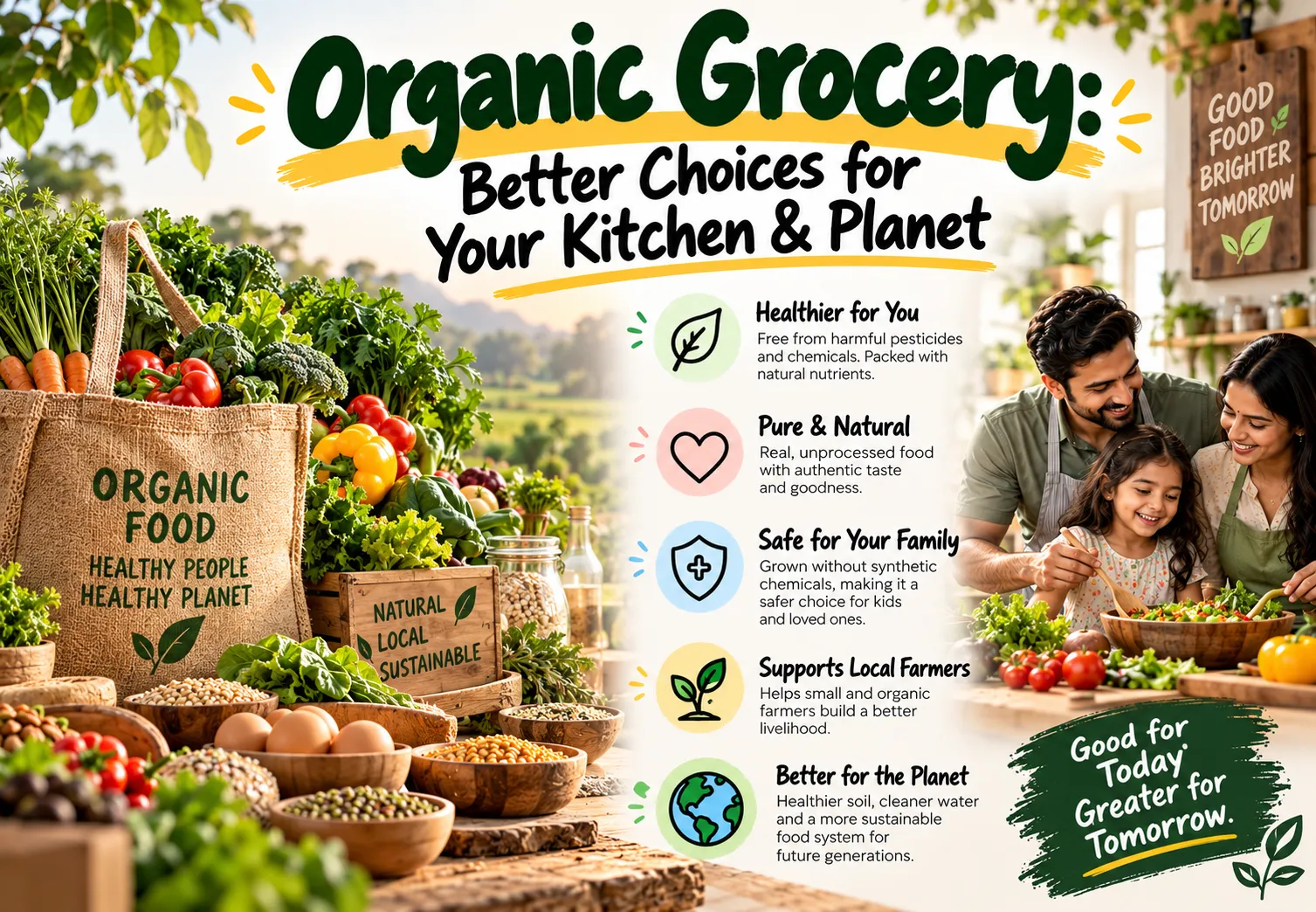
Organic grocery includes food products produced through farming and processing systems that follow defined organic standards. Depending on the certification system, organic production restricts or prohibits certain synthetic pesticides, fertilisers and other inputs.
For your everyday kitchen, this can include millets, pulses, rice, flours, spices, cooking oils, honey, ghee, grains, snacks and other food essentials.
Organic grocery is not simply about buying a different label. It is about being more aware of where our food comes from, how it is produced and what kind of farming systems we support.
Why Should Organic Grocery Be Part of Our Kitchen?
Our kitchen is where many of our everyday food choices begin. Choosing quality ingredients can make meals more enjoyable while helping us build a more diverse and balanced diet.
Organic grocery also gives families an opportunity to explore traditional foods such as millets, unpolished grains, pulses, natural sweeteners and traditionally produced oils.
The goal is not that every product must be organic overnight. Even gradually replacing some everyday products with responsibly produced alternatives can be a meaningful step.
Organic Food and Better Food Choices
Organic does not automatically mean that a food is more nutritious than its conventional equivalent. Nutritional value depends on the individual food, variety, processing and overall diet.
However, organic farming is based on production standards designed around particular agricultural practices and inputs. This makes certification and transparent sourcing important when choosing organic products.
For consumers, checking the appropriate organic certification or trusted sourcing information can help distinguish genuine organic products from products that simply use natural-sounding marketing language.
Benefits of Organic Farming for the Environment
1. Supporting Healthy Soil
Healthy soil is the foundation of sustainable agriculture. Organic farming systems can use practices such as crop rotation, organic fertilisers and other methods intended to support soil biological activity and fertility.
The Food and Agriculture Organization notes that organic agriculture promotes agro-ecosystem health, including soil biological activity and biodiversity.
Healthy soil can also support better water infiltration, nutrient cycling and resilience.
2. Encouraging Biodiversity
A healthy farm is more than crops. It can include soil organisms, insects, plants, birds and other forms of life.
Organic and other diversified farming practices can support agricultural biodiversity and ecosystem functions. Biodiversity plays an important role in processes such as pollination, nutrient cycling and natural pest regulation.
Choosing products from farming systems that value biodiversity can therefore contribute to a more diverse agricultural landscape.
3. Reducing Reliance on Certain Synthetic Inputs
Organic production standards restrict the use of many conventional synthetic pesticides and fertilisers, although organic farming does not mean that no pest-control or crop-protection substances are ever used.
The aim is to follow approved production methods and manage the farm as an interconnected ecosystem.
This can help reduce dependence on certain synthetic agricultural inputs.
4. Protecting Soil and Water
Agricultural practices influence both soil and water quality.
Good soil management can improve water infiltration and reduce runoff. USDA soil-health guidance notes that improved soil structure can reduce runoff and help protect surface-water quality.
Organic farming systems that build soil organic matter and use appropriate crop rotations can therefore contribute to healthier agricultural ecosystems.
Organic Grocery for a More Conscious Kitchen
Choosing organic grocery does not have to mean completely changing the way you cook.
Start with products you already use regularly.
Consider adding:
- 🌾 Organic Millets
- 🫘 Organic Pulses
- 🍚 Organic Rice & Grains
- 🌿 Organic Spices
- 🫒 Quality Cooking Oils
- 🍯 Organic Honey
- 🧈 Traditional Ghee
- 🌾 Organic Flours
- 🥜 Healthy Snacks
- 🛒 Everyday Kitchen Essentials
This makes the transition simple and practical.
Organic Grocery & Traditional Indian Food
India has a long history of diverse grains, pulses, spices and traditional foods.
Millets such as Bajra, Jowar, Ragi, Foxtail, Little, Kodo and Barnyard Millet have traditionally been part of regional diets.
Combining these traditional foods with responsible sourcing can help bring greater variety to modern kitchens while keeping traditional food knowledge alive.
Small Choices Can Create a Bigger Impact
Every grocery purchase supports a supply chain involving farmers, processors, manufacturers, retailers and consumers.
When more consumers look for responsibly produced food, transparent sourcing and sustainable agricultural practices, it can help create greater demand for farming systems that consider soil, biodiversity and natural resources.
Organic food is not a complete solution to every environmental challenge, and organic farming itself has different environmental outcomes depending on crop, location, farming practices, yields, transport and other factors.
But it can be one part of a broader move toward more sustainable and resilient food systems.
Bring Better Choices Into Your Kitchen
At Amruta Goods, we believe that good food begins with thoughtful sourcing.
Our goal is to make it easier for families to discover millets, organic grocery, natural foods, cooking oils, honey, healthy snacks and everyday kitchen essentials in one place.
From traditional grains to modern healthy-food choices, we want to help you make your everyday kitchen more diverse and conscious.
Better Food. Better Choices. A Better Tomorrow.
Explore wholesome food choices with Amruta Goods.
Call / WhatsApp: 82 888 13 66
Shop Online: amrutagoods.com
Amruta Goods — Pure • Natural • Organic